-
The Real Meaning of the Clinton Decision
Podcast: Download
Darrell Castle discusses how the rule of law and the right of the people to govern themselves are in grave danger.
THE REAL MEANING OF THE CLINTON DECISION
Hello, this is Darrell Castle with today’s podcast. Today is Friday, July 8, 2016, and on today’s podcast we are going to discuss the death not only of the rule of law, but of the people’s ability to govern themselves. I’m not going to rehash the information that you already know about James Comey’s press conference in which he said essentially that there was evidence of broken laws, which would have been prosecuted in others but not in one of our Royalty. That is a rough paraphrase but accurate. What I intend to discuss is what the actions of Mrs. Clinton, and what Mr. Comey said about those actions, really mean.
-
Brexit
Podcast: Download
Darrell Castle gives his thoughts on Brexit including the future of self government in the United States and the world.
Transcript…
-
Self Defense Is a Basic Human Right
Podcast: Download
Darrell Castle takes time while on the campaign trail to talk about the right of free people to defend themselves in light of the shooting in Orlando.
Transcript…
-
Original Intent
Podcast: Download
Darrell Castle argues that the original intent of the U.S. Constitution is still relevant today but it is poorly understood and never applied.
-
Original Intent
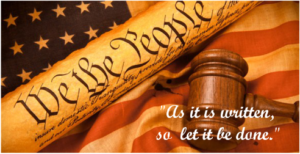 Today we are going to discuss the original intent of the United States Constitution. This is relevant for our discussion because I am the Constitution Party’s candidate for President of the United States and the Constitution Party was formed originally by a group of people who believed that the original intent of the United States Constitution is still relevant today and can be defended intellectually to the nation.
How could the founders imagine, let alone prepare for the possibility that the United States might abandon the correct method of constitutional interpretation (i.e. original intent) and with it abandon the rule of law in general. Today not only has original intent been abandoned but it is not understood by the average American who looks on the mention of it as extremely right wing or at best simplistic.
No judges employ it, and no lawyers argue it. It is not desired by any politicians or by their special interest groups for whom the Constitution’s quaint words and phrases serve only as a cover story for what best lines their pockets.
-
The Function of Law
Podcast: Download
Darrell Castle discusses the intended and original purpose of law and argues that it has been perverted today.
-
The Function of Law
 Today we are going to discuss the law and why it is important to our lives in America today.
Frederic Bastiat was a French economic theorist who died in 1850 at the age of 49 apparently from tuberculosis. His most famous book, The Law, has been the basis of much free market thinking over the years. His last book, Economic Harmonies, was an attempt to explain the workings of the social order under liberty, and how this capacity of people to cooperate is the source of civilization.
In “The Law” he addresses not economic theory but political theory. He asks, what is the law? He argues that it came after liberty and after property. It did not create them. The purpose of law is to serve to bolster the institutions that make social and economic life work. It is the servant, not the master of liberty and property.
His book opens with this statement: “The law perverted! And the police powers of the state perverted along with it! The law, I say, not only turned from its proper purpose but made to follow an entirely contrary purpose! The law become the weapon of every kind of greed! Instead of checking crime, the law itself guilty of the evils it is supposed to punish! If this is true, it is a serious fact, and moral duty requires me to call the attention of my fellow citizens to it.”
-
The Most Important Part of the Constitution
Podcast: Download
Darrell Castle discusses Article 1, Section 1 of the United States Constitution and argues that it is most important.
-
The Most Important Part of the Constitution
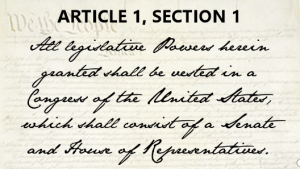 I am often asked by the media in interviews and by the public in question and answer sessions “What is the most important part of the Constitution?”
All of the Constitution is important and a good argument could be made for many sections, including the Bill of Rights, but I believe Article I Section I is most important. “All legislative powers herein granted shall be vested in a Congress of the United States which shall consist of a Senate and House of Representatives.”
With that beginning sentence The Constitution vests all policy making and law making authority of the federal government in congress. The term “vested” means that Congress cannot lawfully surrender or reassign its authority. The vesting of all legislative authority in a congress answerable to “We the People” is perhaps the bedrock premise of our legal system.
-
A Case For Ending The Federal Reserve
Podcast: Download
Darrell Castle explains his reasons why the United States should end the Federal Reserve’s control of the United States’ monetary system.